
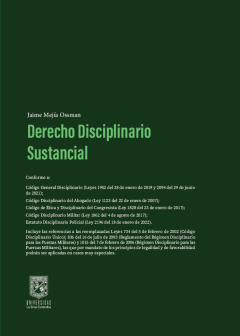
Substantive Disciplinary Law
Keywords:
General Disciplinary Code, Attorney Disciplinary Code, Code of Ethics and Discipline for Members of Congress, disciplinary law, due process, public service, administrative liabilitySynopsis
With this third edition of his work *Substantive Disciplinary Law*, which he has very kindly donated to the university I preside over, Jaime Mejía Ossman wishes to continue offering scholars of the subject the academic insights that have emerged from his dedication and passion for this complex discipline, in the hope that those of us who have a special interest in it will build upon it each day with greater clarity and respect for the social and democratic rule of law and for the constitutional and legal principles upon which it is based.
Likewise, the author of this important resource, by drawing on the Constitution and relying on legal and regulatory provisions, as well as the case law of the High Courts and national and foreign legal doctrine, enables those who consult his work to resolve many questions that hinder the application and interpretation of the current disciplinary theories that have guided the various codifications. I believe that, with the help of this valuable tool, it is reasonable to expect that the day is drawing near when disciplinary law will be administered with the utmost respect for human dignity—a principle that must be upheld in our constitutional, social, and democratic state governed by the rule of law—where due process is always applied in the same manner as it is under criminal law and other punitive disciplines.
For this reason, Dr. Mejía Ossman’s text—as he himself maintains and as others, including myself, have understood it— is not a document intended for general reading but rather a valuable reference tool that examines and delves deeply into the concepts of public service, special relationships of subordination, disciplinary authority, disciplinary action, guiding principles, criminal classification, substantive unlawfulness, and culpability. Regarding these topics, it urges us to avoid applying theories that would contradict our 1991 Constitution, that is to say, it seeks to isolate theories that permit a more lenient interpretation or application of constitutional principles without authorization from the Constitution itself, a position supported by the law, judicial precedent, the reasoning of the High Courts, and certain works containing national or international doctrine specializing in disciplinary and/or punitive matters.
Similarly, in this work, the author clearly sets forth his interpretation of the topics addressed here, as well as the views of our Constitutional Court and the higher courts; those of the Office of the Attorney General of the Nation, as expressed in consultations with the Assistant Attorney General’s Office for Disciplinary Affairs; and the positions of the most prominent national and international legal scholars, enabling those who study the topics discussed therein to acquire practical tools for developing their professional judgment and thus contribute to the development of disciplinary law that remains faithful to the constitutional, social, and democratic rule of law, the Political Constitution, and the current Article 3 of Law 1437 of January 18, 2011 (CPACA).
Consequently, this third edition of *Substantive Disciplinary Law* is an invitation to all scholars, those with a keen interest in the subject, and specialists in this field to expand upon, refine, or enrich the various topics that make up this extremely important discipline of the State’s punitive law, with the support of the Constitution for the application and interpretation of Laws No. 1952 of January 28, 2019, and No. 2094 of June 29, 2021 (General Disciplinary Code); Law No. 1123 of January 22, 2007 (Disciplinary Code for Attorneys); Law No. 1828 of January 23, 2017 (Code of Ethics and Discipline for Members of Congress); Law No. 1862 of August 4, 2017 (Military Disciplinary Code) and Law 2196 of January 18, 2022 (Police Disciplinary Statute), with the certainty that only through true disciplinary justice—carried out in accordance with respect for human dignity and the other constitutional and legal guarantees of those involved in disciplinary proceedings—can the principles, purposes, and functions of the State be protected.
Chapters
Downloads
References
Disponibles en el texto.
Downloads
Published
Series
Categories
Data Availability Statement
Not applicable
License

This work is licensed under a Creative Commons Attribution-NonCommercial-ShareAlike 4.0 International License.