
Chapter III. Systems of independent thought: Water, independent education, and an economy for life

Authors

Misael Tirado Acero
Universidad La Gran Colombia
https://orcid.org/0000-0003-1840-1702
Miguel Ángel Chaparro Izquierdo (Dodoringumu)

Synopsis

This chapter analyzes indigenous systems of thought related to water, indigenous education, and economies for life, highlighting their role as ontological and epistemological foundations in various indigenous communities. It examines how these systems shape ways of relating to, interpreting, and caring for the territory, in which water is conceived as a living and sacred being that organizes life and community harmony. The text delves into the principles of reciprocity, horizontality, pluriversality, and dialogue of knowledge as the foundations for building intercultural governance that overcomes the cognitive hierarchies imposed by Western models and promotes more symmetrical relationships between ancestral and institutional knowledge. It also reflects on the importance of strengthening spaces for self-education and traditional practices that have historically been rendered invisible, with the aim of contributing to sustainability, territorial justice, and the preservation of life. Finally, it raises the need to integrate these systems of thought into educational, institutional, and water management processes to advance toward forms of territoriality that recognize the ontological and epistemic diversity of Indigenous peoples.
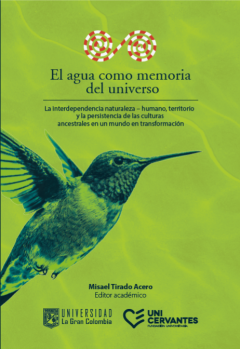
Author Biographies

Misael Tirado Acero, Universidad La Gran Colombia

He holds a postdoctoral degree in Law from the University of Buenos Aires, a Ph.D. in Legal Sociology and Political Institutions from the Externado University of Colombia, a specialization in Social Project Evaluation and a specialization in Economics from the University of the Andes, and a degree in Sociology from the National University of Colombia. Research professor at La Gran Colombia University, affiliated with the School of Law and Political and Social Sciences, and a member of the Contemporary Criminal Law research group.

Miguel Ángel Chaparro Izquierdo (Dodoringumu)

Member of the Arhuaco Nabusimake community, Pueblo Bello (Cesar, Colombia). He holds a Master’s degree in Public Administration from the Universidad de los Andes and a degree in Government and International Relations from the Universidad Externado de Colombia. He serves as a delegate appointed by the Mamus to facilitate dialogue between the Arhuaco people and the Western majority society and its institutions, including the Supreme Courts, ministries, the Attorney General’s Office, and the Ombudsman’s Office.

Published

March 31, 2026

How to Cite

Tirado Acero, M., & Chaparro Izquierdo, M. Ángel. (2026). Chapter III. Systems of independent thought: Water, independent education, and an economy for life. In (Ed.), & M. Tirado Acero, C. A. Laverde Rodríguez, L. F. Ortega Guzmán, M. F. Blanco Pineda, D. F. Rey Guerrero, M. Ángel Chaparro Izquierdo, G. Monroy Quecán, A. I. Jiménez Barón, A. Z. Izquierdo Suárez, & E. M. Caicedo Fraide, Water as the memory of the universe: The interdependence of nature and humanity, the land, and the persistence of ancestral cultures in a changing world (pp. 111-136). Editorial Universidad La Gran Colombia. https://omp.ugc.edu.co/index.php/catalagoeditorial/catalog/book/978-628-7626-66-9/chapter/258