
Forum 1. Architecture, pedagogy, and the environment
Synopsis
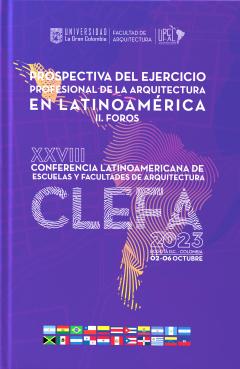
Forum 1, on architecture, pedagogy, and the environment, within CLEFA 2023, is part of thematic table 1, architecture and the environment in Latin America: commitment to the proper management of resources, quality of life, and the implementation of technologies in professional practice. This approach seeks to problematize the fields of action of technologies in architecture in order to generate critical social responsibility regarding their implementation and impact on the environment and communities. This forum emphasizes the pedagogical aspects of architecture, implicit in the relationship between technology and the environment. Within this context, the basis for Forum 1 was established based on the question: What role should architecture professionals play in the proper management of resources and the implementation of technologies to improve quality of life in different contexts and territories?
It is vitally important to recognize the pedagogical processes that stem from methodological approaches in architecture, where exploration and experimentation are fundamental to the design and construction processes. Likewise, new methodologies such as design thinking have come to the forefront of contemporary pedagogy to experiment with other ways of doing architecture and developing creative thinking. Throughout CLEFA 2022 and CLEFA 2023, reflection arose on traditional ways of teaching architecture. This is an issue that concerns a professional practice linked to traditional academic approaches. These ways of doing, understanding, and teaching architecture are currently at stake and are being questioned due to the impact of new technologies and their scope, especially in the ways of constructing reality. Likewise, we recognize the impact of these technologies as tools for improving quality of life and the environment. The use of traditional techniques in relation to technological advances is highlighted, which is why it is essential to appropriate technologies to design processes from academia in order to improve creative processes and develop critical thinking. Issues concerning the application and use of technologies specific to each era, which are fundamental to progress in creative processes and environmental awareness that should be promoted in schools and faculties of architecture, continue to be a subject of debate.
Ponencias:
- Javier Erasmo Maradiaga Betancourt (Honduras) with the presentation: “The city system and environmental balance. The case of Honduras.”
- Celso Lomonte Minozzi, Rafael Manzo and Silvio Stefanini Sant’Anna (Brazil) with the presentation: “Architecture – critical vocabulary of construction.”
- Humberto Enrique Brito Figueroa (Dominican Republic) with the presentation: “The environment in the Dominican Republic. Problems and challenges.”
- Carlos Esteban Contreras Lojano, Andrés Rolando Quizhpi Piedra and María Paz Galarza Farfán (Ecuador) with the presentation: “Comparison of construction systems applied to 36m2 social housing (VIS) promoted by MIDUVI in Planning Zone 6 - Austro, between the typologies of 2018 and 2022.”
- Fabian Enrique Báez Álvarez, Katherine del Carmen González Rivera, Danna Catalina Ángel Rubiano and José Agustín Almario Castillo (Colombia) with the presentation: “Architectural Languages + Design Thinking.”
- Alexandra Mercedes Fabián Rojas (Perú) with the presentation: “Architecture in its three basic elements of quality of life as a pedagogical methodology and its environmental impact on urban planning in the Mantaro Valley.”
Pages
Published
Series
Categories
License

This work is licensed under a Creative Commons Attribution-NonCommercial-ShareAlike 4.0 International License.